
Useful Information for Dietitians managing PWS patients
The purpose of this page is to signpost dietitians who are managing patients with PWS to reliable and useful information that will aid successful management.
For more dietetic advice please contact us, we can pass on your question to members of the PWS Dietitian Network.
If you would like to join the Network, which shares information and advice about PWS, contact supportteam@pwsa.co.uk
Practical Portions
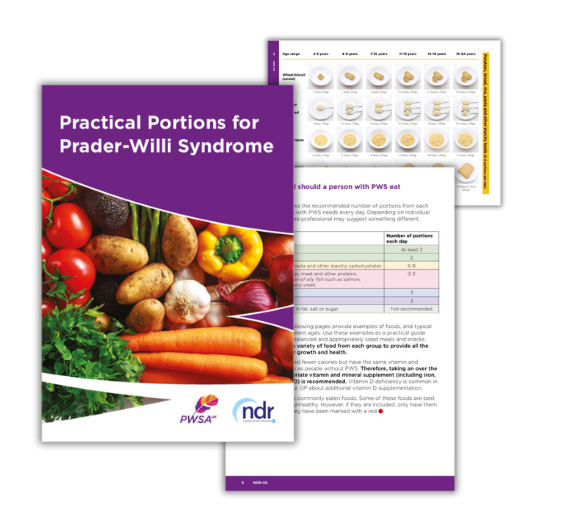
Practical Portions for PWS is a free resource specially created by expert PWS dieticians and nutritionists. It's designed to make it easy to work out appropriate portions for people with PWS to ensure their nutritional needs are met while maintaining a healthy weight.
Click the image to read Practical Portions online, or to download.
Order a physical copy, here.
Phases
Historically two distinct phases are characteristic of this syndrome. At birth, infants present with hypotonia and feeding difficulties and subsequently have faltering growth. A large US study, Nutritional Phases in Prader–Willi Syndrome published in 2011 has proposed a more gradual and complex range of phases. In total seven different nutritional phases are described (five main and two sub-phases) each with distinct characteristics. It can be useful to identify the stage of the person with PWS to help prepare families with information relevant to the next phase. A paper (2011) published in Paediatrics, Health Supervision for Children With Prader-Willi Syndrome lays out more generic phases of PWS to be aware of and provides a good overview.
Growth assessment
The inherent growth pattern of PWS children varies from children who do not have PWS. PWS growth can be associated with early childhood obesity, absent pubertal growth spurt and adolescent short stature. Subsequently, plotting on WHO growth charts may make growth interpretation difficult.
Several PWS specific growth charts have been proposed and produced from groups in Japan, Germany and the US. For non-growth hormone treated infants from birth to 36 months, growth charts from US data were published in 2010. See Growth Standards of Infants With Prader-Willi Syndrome.
In 2015, growth charts (including BMI charts) were produced from further US data for non-growth hormone treated children from 36 months to 18 years. See Growth Charts for Non-Growth Hormone Treated Prader-Willi Syndrome.
In 2016, growth charts for growth hormone treated children with PWS in the US were published. General consensus, however, among PWS experts in the UK is not to use PWS charts for several reasons including population differences.
Use of body composition and skin fold can be useful for ongoing monitoring, but no standards or reference data exists at this point specific to PWS.
Nutritional requirements
Due to low muscle tone and abnormal body composition, the child or adult with PWS requires a considerably lower energy intake than their non-PWS peers. Limited studies have evaluated the caloric requirements and calculating specific caloric requirements for PWS children is controversial. There is particular uncertainty on energy requirements for small children. A general recommendation of approximately 60% of the calories for age is a commonly used target in children. It is worth noting some recent work (2023), however, has challenged this but care should be taken in the application of this single study.
Recommendations for caloric intake in adults with PWS for ensuring weight maintenance have evolved from 8.4–14.6 kcal/cm ht – 0.0–14.0 kcal/cm ht – In clinical practice, intakes of 14 kcal/cm may provide significantly over the needs of a PWS patient so working on the lower end of these recommendations (10 kcals/cm) would be the appropriate starting point.
For weight reduction, the recommended range is 6-8kcal/cm ht.
Caloric goals should be regularly evaluated and adjusted in the context of the child’s growth pattern.
Micronutrient requirements do not appear to be different than age matched non-PWS people. Dietary analysis of intakes can be useful and should be part of dietetic assessment. Particular care to observe calcium, iron, zinc, Vitamin D and selenium intake is recommended, as supported by several research papers in this area. See Nutritional intakes in children with Prader-Willi syndrome and non-congenital obesity and Nutrient intake of young children with Prader Willi syndrome.
Dietary treatment
In the first year of life NG feeding may be required as sufficient intake may be limited by symptoms such as weak suck and early tiring. Use of nutrient dense formula may be required if growth failure occurs (i.e. centile changes in line with NICE guidelines on Faltering Growth).
If NG feeding and/or the use of nutrient dense formula are required, close monitoring of the child’s growth pattern is recommended to prevent over feeding or excessive weight gain.
Overall care should be taken to closely monitor intake and growth. Acceleration in weight gain can occur quickly and therefore regular reviews are helpful.
As a result of lower caloric but similar micronutrient requirements, care must be taken in balancing the diet as the child grows. Dietetic attention is required in the provision of sufficient calories and nutrients for growth balanced with avoiding an excess of calories leading to unwanted weight gain. Prevention of over-restriction, particularly in the younger, more vulnerable, infant is of particular importance.
In older children and adults with PWS, several broad nutritional approaches have been proposed:
- The Traffic light-Red yellow green approach developed in Canada
- Modified carbohydrate
- Food pyramid
- Classic low calorie/low fat
- Modified macro nutrient proportions (higher protein, reduced carbohydrate)
No studies have compared all the different approaches to evaluate the most successful. Many agree the most important principle is finding a strategy that can be consistently adhered to.
In adulthood, the main dietary concern is obesity; many causes of premature death occur due to complications arising from this, therefore weight management is the main focus of dietary treatment.
The most effective results are seen when a strictly calorie-controlled regimen is adhered to.
Care should be taken to ensure prevention of over restriction of fat (<20% of total caloric intake). This has been shown in several reviews to be associated with PWS diets and could lead to insufficient essential fatty acid intake in key periods of development.
Recent interest has grown in the use of ketogenic diets with PWS patients including published studies such as Positive effects of ketogenic diet on weight control in children with obesity due to Prader-Willi syndrome - PubMed (nih.gov). Currently the data remains limited and the use of these is not recommended in UK centres.
Constipation can be common in those with PWS and the usual dietary treatments and prevention strategies can be applied and are outlined in the NICE guidelines 2010. Delayed stomach emptying also appears to be common.
Pharmacological treatment options have recently been reviewed (2023) and this paper summarises the evidence to date.
Resources for families and care providers
Need to Know Nutrition - an excellent Australian produced booklet is available to download which covers many aspects of nutritional management in PWS. This is designed for families and it may be very useful to provide the link of this to parents as a reliable source of information.
Many useful DVDs have been produced. Of note Food, Behaviour and Beyond – Practical Management for the Child & Adult with PWS was produced by the Pittsburgh Partnership in partnership with PWSA USA www.pwsausa.org and the International PWS Organisation (IPWSO).
Locks for cupboard and fridges have long been recommended and actually may provide some positive security to the patient with PWS. The instigation of these is often by parental choice. A useful and concise document has been produced by the US PWS association on the practicalities.
Diet within the overall management of PWS
Many chapters and papers exist on the overarching topic of successful management. Of note a particular useful publication, Regulation of Weight in Prader‐Willi Syndrome: Theoretical and Practical Considerations covers many of these areas and provides practical information that dietitians and PWS families will find very useful.
Also useful is Recommendations for the Diagnosis and Management of Prader-Willi Syndrome (2008).
Activity
Many individuals with PWS tend to prefer sedentary activities such as puzzles, word searches and computer games. However, increasing physical activity levels can increase energy expenditure and overall feelings of wellbeing. Some activities are physically difficult for those with PWS due to poor muscle strength, but walking and swimming can be accomplished by most and should be encouraged to increase energy expenditure. Exercise and Physical Activity for Children with Prader-Willi Syndrome is a very useful booklet to recommend to parents produced by an Australian group. Of particular use is Table 1 which shows the energy cost of some common activity for children.
A recent systematic review concluded that exercise was of benefit and should be optimised in PWS (Morales, Valenzuela et al. 2019). Several strategies have been shown to positively influence continued participation in exercise for PWS children, including encouraging the individual to help choose the types of exercise (Shields, Westle et al. 2020).
Supplements
There is much discussion on supplement use in the PWS population. Standard over-the counter age appropriate multivitamins and minerals are advised in many clinics. If there is any doubt, formal nutritional analysis using programmes such as DietPlan can be very useful. Additional supplementing by parent choice is common and two supplements of particular note are carnitine and co enzyme Q10. Both have been investigated in the context of PWS. Carnitine and Coenzyme Q10 Levels in Individuals with Prader-Willi Syndrome, 2011 provides a good overview behind the theory of both of these. The topic of Carnitine and Coenzyme Q10 are discussed separately in depth on a popular website for parents called Connecting the PWS dots.
Surgery
Families may ask about bariatric procedures to address excess weight. This topic was reviewed in 2008 in the JPGN article Critical Analysis of Bariatric Procedures in Prader Willi Syndrome which concluded that various surgical interventions had poor results in PWS patients in comparison with obese individuals. A further observational study published more recently in 2019 (Bariatric surgery for Prader-Willi syndrome was ineffective in producing sustainable weight loss: Long term results for up to 10 years - PubMed (nih.gov)) concluded that bariatric surgery cannot be recommended to PWS patients as a standard treatment. Diet and careful strategic management remain the most appropriate long term therapy. A recent (2023) narrative review covering this topic has recently been published with a systematic review and meta analysis (2023).
Transition to adult care
Ideally a paediatric patient with PWS should be handed over and remain under an adult dietitian with an interest and experience in PWS. In some areas this may come under the remit of the Learning Disability Team. As in paediatrics, despite years of research, no drug regimen or behaviour modification successfully and consistently curbs unsupervised over eating in adults with PWS. Monitoring in adults is as important as in paediatrics and, as the child approaches transition, education and identification of tools for adult life should be discussed and recommended.
There are 4 basic options for adult patients with PWS:
- Living with parents or other relatives
- Group home placement
- Supported living services
- Specialised residential services
Each may require different levels of nutritional and weight monitoring depending on the level of support, food access, activity etc.
A 2023 paper on the process of transition is recommended reading for this situation.
Whatever the place of residence, the guidance on dietary restrictions is the same. It is widely acknowledged that adults with PWS likely lack capacity relating to food choices (when and how much) and so there is a duty of care to support the individual to manage their food intake appropriately.
Useful strategies for supporting adults with PWS include:
- Structured menu plan containing well balanced, calorie controlled guidance
- Locked kitchen and/or food cupboards
- Supervised access only to kitchen and food cupboards
- Money and food should not be left lying around
- Consistent approach from all involved
- Be mindful of all opportunities to access foods, e.g. telephone ordering, shops, leftovers, bins
- Monitor weight regularly
- Non-food based rewards can be helpful in encouraging positive behaviours
A useful Australian paper from 2013, Prader-Willi Syndrome. Care of Adults in General Practice, describes common issues that require addressing in adult PWS patients.
There is generally limited data on the physical issues for adults with PWS but this is covered most recently in a paper from 2011 Physical health problems in adults with Prader-Willi syndrome.
Monitoring of weight should be done regularly and assessed by both the raw figures and in terms of BMI’s. Consistent use of standard adult UK BMI charts should be used. At this time, as far as the author is aware, no PWS adult specific BMI charts exist. Although it may be more difficult for an individual with PWS to obtain a healthy weight, it is possible - and, just like the rest of the population, a BMI within the healthy weight range should be the aim.
Summary
Obesity should no longer be seen as an inevitable outcome for persons with PWS. Dietitians are key members of the child or adults support team and building good relations with families and providing reliable sources of up to date information is an important responsibility.
Weight control and even weight loss are achievable and often associated with improved behaviour (due to the establishment of routines and rules that are clear), and importantly a sense of pride and achievement for the individual with PWS.
Prepared by Chris Smith SRD Senior Paediatric Dietitian Royal Alexandra Children’s Hospital Brighton Chris.smith53@nhs.net
Additional material on dietary management for adults
Jane Willis Specialist Dietitian, Learning Disabilities Claverhouse Social Work and Health Dundee, DD4 9FF
Dalhia Campbell Specialist Dietitian Learning Disability Nutrition and Dietetic Service Health and Social Care Claverhouse East Dundee